What Benefits Should a Home Care Agency Offer Caregivers?
Seven benefits are worth pricing: paid orientation, paid time off, predictable hours, a wage increase, group health, dental and vision, and a Section 125 wellness plan. Four cost under $600 per caregiver a year. Two cost between $3,359 and $7,885. One is funded by payroll tax the agency already pays. Most owners only ever price the expensive two, then stop.
Open the careers page for any national home care franchise brand and read a caregiver posting.
Most name no benefits at all. The same site, that same week, lists the role at $16.00 an hour.
That is not sloppy writing. There is usually nothing to name. At most agencies the only person with health coverage is the owner, and the owner knows it.
What is missing is the interesting part. Not group health. Nobody expects group health at that wage. Paid orientation is missing, and so is a block of paid time off, and a schedule posted two weeks out. Those three cost a fraction of a raise. They are absent from nearly every posting because owners priced a raise and a group plan, watched both fail, and closed the subject.
What does each benefit actually cost per caregiver?
Every figure below assumes one caregiver at 30 hours a week, 1,560 hours a year, earning $16.78 an hour. That rate is the federal median for home health and personal care aides, which puts annual wages near $26,177. Adjust for your market and the ranking below does not move.
| Benefit | What the caregiver gets | Cost per caregiver per year |
|---|---|---|
| Paid orientation and training | 8 hours onboarding, 12 hours ongoing, paid at wage | About $361 |
| Paid time off | Five six-hour paid days | About $542 |
| Predictable scheduling | Two-week advance posting, protected hours | No new payroll |
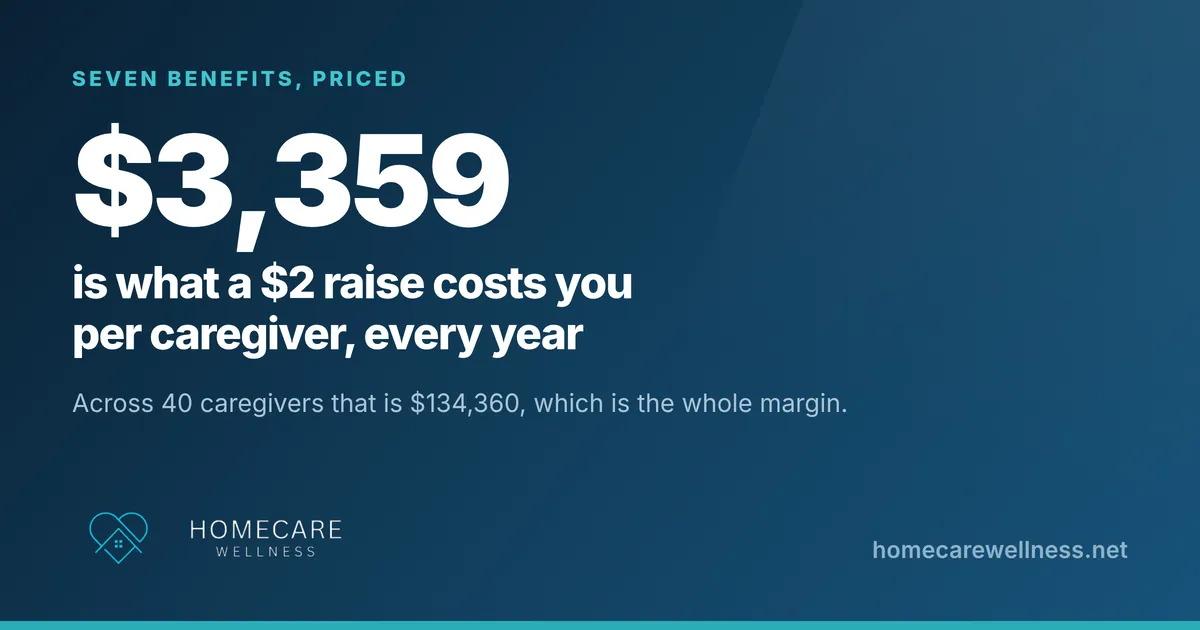
| $2.00 an hour raise | About $60 more per week, pre-tax | $3,359 |
| Dental and vision | Exams, cleanings, frames | Varies by market |
| Group health, single coverage | Major medical | About $7,885 employer share |
| Section 125 wellness plan | Telehealth, preventive care, prescription and mental health support | Funded by payroll tax already paid |
The $2.00 raise figure is $3,120 in wages plus $239 in employer FICA. The group health number comes from the KFF 2025 Employer Health Benefits Survey. The gap between the top three rows and the bottom two is the whole story.
Do caregivers even want the cheap ones?
They want pay first. In the 2025 HHAeXchange caregiver survey, 72.3 percent of more than 8,200 caregivers put higher compensation at the top.
Read the next two lines though. Flexible scheduling came second at 28.2 percent. Additional training came third at 21.7 percent, up from 14.5 percent the year before.
Those are the two cheapest rows in the table, and turnover across the industry still sits near 75 percent, according to the 2025 Activated Insights benchmarking report.
“I already ran this. I cannot afford benefits.”
You are almost certainly right about what you priced.
A $2.00 raise across 40 caregivers is $134,360 a year. On a $2.5 million agency running an 8 percent net margin, that is roughly two-thirds of the annual profit. Group health for the same roster is worse.
Both of those need money the business does not have. That is the correct conclusion from those two inputs, and it is why the subject gets closed.
The Section 125 row is different because the money does not come from margin. Employee contributions come out pre-tax, which lowers the wage base both sides pay FICA on. The employer payroll tax that stops going out is what funds the benefits. We wrote up how a Section 125 wellness plan works inside a home care agency separately.
Is that last row a gimmick?
Fair question, and the category has earned it. Some of what has been sold under this heading deserved the skepticism you have read.
Section 125 itself is not new. It was added to the tax code by the Revenue Act of 1978 and it is the same provision that lets employees pay health premiums pre-tax, described plainly in IRS Topic 751. What regulators objected to was one specific design that ran the same dollars through the code twice.
The distinction matters more than any assurance we could offer, so we do not offer one. CBIZ wrote the compliance opinion on this plan and HitesmanLaw wrote the legal review. Both go to an agency owner before signing. If that is the part you are stuck on, the page about whether these plans are legitimate takes it apart properly.
Where does this fall down?
Not every caregiver qualifies. A Section 125 election needs enough taxable wages for the pre-tax contribution to work. In one recent proposal, 50 of 70 employees qualified. That is 71 percent, not everybody, and an owner who was told to expect full participation was told wrong.
It also does not replace major medical. If a caregiver needs surgery, this is not the coverage that pays for it.
Part-time status is not the disqualifier people assume. The 30-hour threshold is a group carrier rule and it has nothing to do with cafeteria plan eligibility. A Section 125 election is open to W-2 employees regardless of hours. What changes with hours is how much each person gains.
So which lines are worth offering first?
In this order.
- Paid orientation and training, about $361 a year per caregiver. It answers the survey line that grew fastest.
- A block of paid time off, about $542. The one item here a caregiver can picture on the day you announce it.
- Schedule reliability, which costs management attention rather than payroll.
- A Section 125 wellness plan, because it does not compete with the first three for budget.
- Group health, when the margin genuinely supports it and not before.
An agency running the first four can write a recruiting ad that names specific things. The agency down the street is still writing flexible scheduling and making a difference, because that is what is available to them. More on this in our caregiver retention write-ups and under benefits and compliance.
What would this look like at your agency?
Two inputs answer it. How many caregivers you have, and roughly what they earn. That is the whole ask and it stays small on purpose.
The estimator takes those two numbers and shows what your agency currently pays in employer payroll tax, what turnover at the industry median costs you, and what could be redirected into caregiver benefits instead.
Open the estimatorFree. No signup. Nothing stored. For scale, UnifyWell's published example nets an employer about $640 per participating employee per year on a $44,000 earner, and across our own proposals the figure has landed between $300 and $900. That is a range, not a quote. Which of your caregivers qualify, and what lands on each check, only your own numbers can answer. Have your CPA read the plan documents.
Home Care Wellness is a marketing and enrollment partner, not a tax advisor, law firm or insurance carrier. Nothing here is tax, legal or benefits advice. Savings figures are estimates and vary by wage levels, participation and plan design. Plan compliance documentation is prepared by CBIZ and HitesmanLaw and is available for your own advisors to review before you enroll.