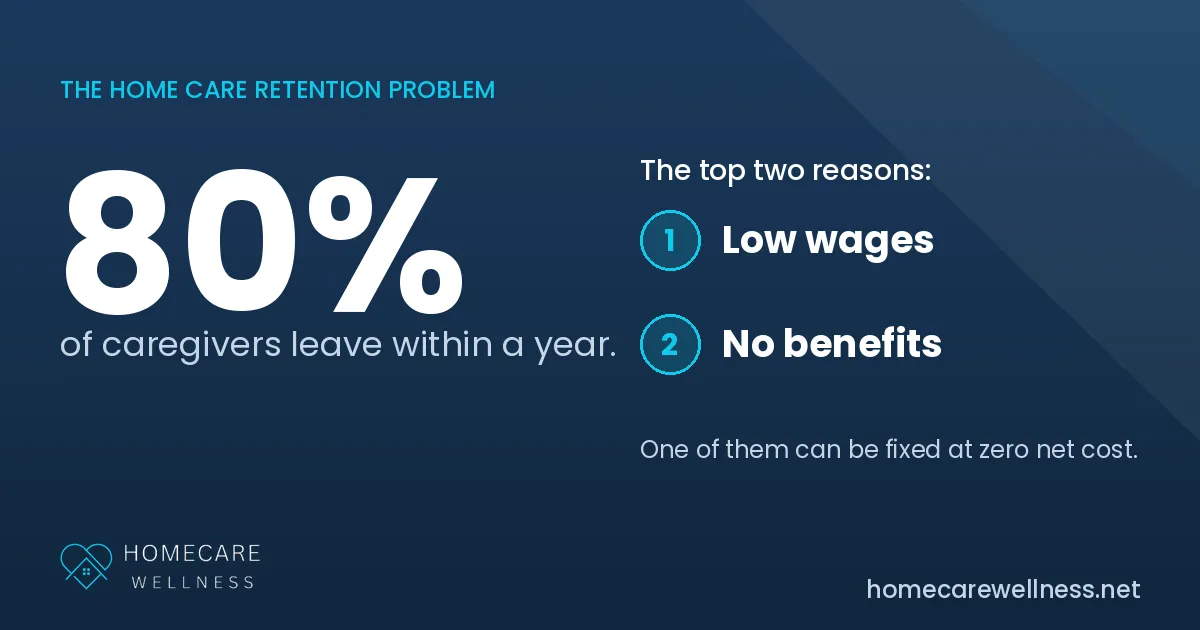
Why $150 in Benefits Beats a $150 Raise for Your Caregivers
$150 a month in benefits and $150 a month in wages are not the same $150. A raise is taxable wages, so it reaches the caregiver only after withholding, and it costs you another 7.65 percent in employer FICA on top of the raise itself. A benefit funded through a Section 125 wellness plan arrives whole, and the employer side comes out of payroll tax you already send. Same number on paper.
Open the careers page of any national home care franchise brand operating near you. The job posts carry an hourly rate. Scroll to what the company offers and you will usually find flexible scheduling, paid training and a referral bonus, which is the same list you would have written yourself five years ago. That is it.
The reason is arithmetic, and it is the same at almost every agency. An owner running a 7 to 10 percent net margin priced a raise, then priced a group plan, saw a number bigger than the year's profit sitting next to a roster of 40 caregivers, and closed the spreadsheet. The math was right. The question was wrong.
You already ran this math on a raise
Two dollars an hour on a 30-hour caregiver is $3,120 a year, and once you add 7.65 percent in employer FICA the real cost is $3,359 per caregiver. Across 40 that is $134,360, close to what replacing caregivers at industry turnover already costs the same roster. Shrink the raise to $150 a month. The shape holds.
The caregiver does not receive $1,800 of that. You spend $77,508 to put something smaller than $77,508 into forty households that were already short.
What does $150 buy that a raise does not?
A dollar of wages competes with rent and gas the moment it lands. A benefit removes one bill instead, and the money that had been covering it every month stays in the household.
Rosa averages three days a week at your agency and picks up a second day elsewhere. Her mother lives with her and takes a blood pressure medication that runs about $150 a month at the counter, which is the kind of bill that decides what else happens that week. Under the plan's pharmacy benefit that generic costs nothing. Rosa did not get a raise. She works for two agencies and pays attention to the one that did this.
Composite example, not an actual member.
My caregivers are part-time. Does that rule them out?
The 30-hour threshold you are thinking of is a group health carrier rule. It is not tax law. A Section 125 election is open to W-2 employees regardless of hours, which is why a roster that cannot qualify for group coverage can still participate here.
The plan structure carries a CPA opinion from CBIZ and a legal assurance from HitesmanLaw. Detail sits on the compliance page, and the first question owners ask is answered at is a Section 125 wellness plan legit.
Where this does not work
This is not health insurance and no caregiver should be told it is. No hospital, no surgery. It is telemedicine, pharmacy, dental and mental health support, which is what a caregiver actually receives. On a roster of six or eight people the per-employee return is usually too thin to be worth the administration that comes with running a plan.
What would this look like at your agency?
Two inputs answer it. How many caregivers you employ, and what they earn. That is the whole ask, and it stays small on purpose, because nothing else is needed to put a real number in front of you before you decide anything.
The estimator takes those numbers and shows what you currently pay in employer payroll tax, what turnover at the industry median costs you, and what could be redirected into caregiver benefits instead. Thirty seconds, no signup.
For scale, UnifyWell's published example nets an employer roughly $640 per participating employee per year on a $44,000 earner, after the monthly administration fee is taken out. Caregiver wages sit below that. Across Home Care Wellness's own proposals the figure has landed between $300 and $900 per participating employee per year. That is a range, not a quote. Which of your caregivers qualify, and what lands on their check, only your payroll can answer. Have your CPA read the plan documents first.
See what your payroll tax is already funding
Enter your caregiver count and average wage. The estimator shows what you pay now and what could go to benefits instead.
Free, no signup, about thirty seconds.
Home Care Wellness is not a law firm, an accounting firm or an insurance company, and nothing written on this page is intended as legal, tax or accounting advice. This is not insurance. Any savings figure is an estimate that depends on your payroll, participation and state. Compliance opinions are issued by CBIZ and HitesmanLaw. Consult your own CPA before adopting a plan.