The Real Cost of Replacing a Caregiver at a Home Care Agency
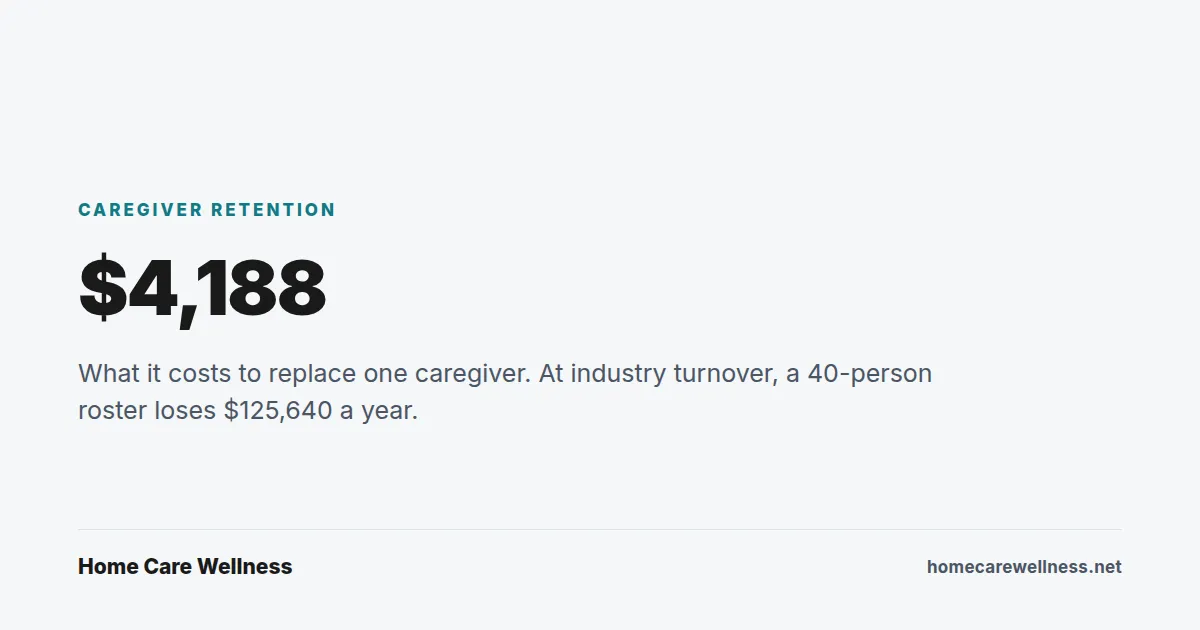
Replacing one caregiver costs a home care agency about $4,188. At the industry turnover rate, a 40-caregiver agency loses 30 people a year, which is roughly $125,640. The $2.00 raise most owners price and reject costs $134,360. The two numbers are within nine thousand dollars of each other, and only one of them appears anywhere in the books.
Turnover has no line on a profit and loss statement.
Look for it. There is no row called turnover. There is advertising, which went up. There is overtime, which went up. There is the scheduler's salary, which did not change even though her afternoon did. There is a client who met four different caregivers in six weeks and quietly started calling other agencies.
All of it is real money and none of it files under one heading.
That is why an owner can tell you exactly what a $2.00 raise would cost, down to the dollar, and cannot tell you what last year's turnover cost. One number lives in a spreadsheet. The other is scattered across six accounts and a bad quarter.
What does one departure actually cost?
The most durable estimate comes from a Center for American Progress meta-analysis of 31 case studies, which found that replacing an employee earning under $30,000 a year costs about 16 percent of that annual salary.
Apply it to current wages. The federal median for home health and personal care aides is $16.78 an hour. At 30 hours a week that is $26,177 a year.
Sixteen percent of $26,177 is $4,188.
That figure is not one invoice. It is spread across these:
| Where it goes | What drives it |
|---|---|
| Job advertising | Per-post or per-lead fees, paid again for every opening |
| Screening and interviews | Owner or scheduler hours, none of them billable |
| Background check and onboarding | Per-hire vendor cost |
| Paid orientation | About $361 for 20 paid hours at the median wage |
| Overtime covering the gap | Premium pay on every shift until the role is filled |
| Supervision during ramp-up | Corrections, check-ins, and the calls that come with a new face |
| Client churn risk | The hardest to price and often the largest |
What is that across a full roster?
Turnover in home care runs near 75 percent, according to the 2025 Activated Insights benchmarking report.
An agency with 40 caregivers loses 30 of them in a year. Thirty departures at $4,188 is $125,640. Those thirty openings also have to be filled, and 313 applicants a year is where the owner's own week goes.
Now put that next to the raise. Two dollars an hour on a 30-hour caregiver is $3,120 in wages plus $239 in employer FICA, which is $3,359 each. Across 40 caregivers, $134,360.
The gap between those two numbers is under nine thousand dollars.
The raise gets rejected because it is visible and it arrives as one decision. The turnover bill gets paid because it is invisible and it arrives in pieces.
“So I should just give the raise?”
No, and this is where the arithmetic gets misused.
A raise does not convert turnover spend into retention spend at par. You pay it to all 40 caregivers, including the ones who were never going to leave, and it does not remove the departures. It reduces them by some amount nobody can promise you in advance.
Read the comparison as a floor instead of a plan. You are already spending roughly what the raise would cost. The question is not whether the money exists. It does. The question is whether it is buying you anything.
Right now it is buying you the same thirty vacancies you had last year.
Where is this estimate soft?
The 16 percent figure comes from a 2012 meta-analysis. It is the most rigorous number available for low-wage replacement cost, and it is old. Wages have moved a great deal since. Applying the percentage to current wages is defensible, but it is a percentage borrowed from other industries, not a measurement of your agency.
Turnover rates also vary enormously. An agency at 45 percent and an agency at 95 percent are not in the same business, and the roster-wide number moves with them.
Your own figure is knowable, and it is better than ours. Count last year's departures. Multiply by $4,188. Then argue with the multiplier.
What actually moves the number?
Pay is the first answer caregivers give. It is also the most expensive one to act on, which is why most agencies stall there.
The two answers underneath it are cheaper. Schedule reliability costs management attention rather than payroll. Paid orientation runs about $361 a year per caregiver and it is the line that grew fastest in caregiver surveys.
Benefits are the fourth lever, and the reason they usually get skipped is cost. That is where a Section 125 wellness plan sits, because it is funded by employer payroll tax the agency is already sending out rather than by margin. We covered what each caregiver benefit costs per year and how the plan works inside an agency separately. If the mechanism sounds too convenient, we wrote about whether these plans are legitimate as well.
What is turnover costing your agency?
Two inputs. How many caregivers you have, and roughly what they earn. That is the whole ask and it stays small on purpose.
The estimator takes those numbers and shows what you currently pay in employer payroll tax, what turnover at the industry median is costing you, and what could be redirected into caregiver benefits instead.
Open the estimatorFree. No signup. Nothing stored. UnifyWell's published example nets an employer about $640 per participating employee per year on a $44,000 earner, and across our own proposals the figure has landed between $300 and $900. That is a range, not a quote. Which of your caregivers qualify, and what lands on each check, only your own numbers can answer. Have your CPA read the plan documents.
Home Care Wellness is a marketing and enrollment partner, not a tax advisor, law firm or insurance carrier. Nothing here is tax, legal or benefits advice. Cost figures are estimates built from published third-party research and vary by market, wage level and agency. Plan compliance documentation is prepared by CBIZ and HitesmanLaw and is available for your own advisors to review before you enroll.