Caregiver Turnover Math: 30 Hires and 313 Applicants a Year
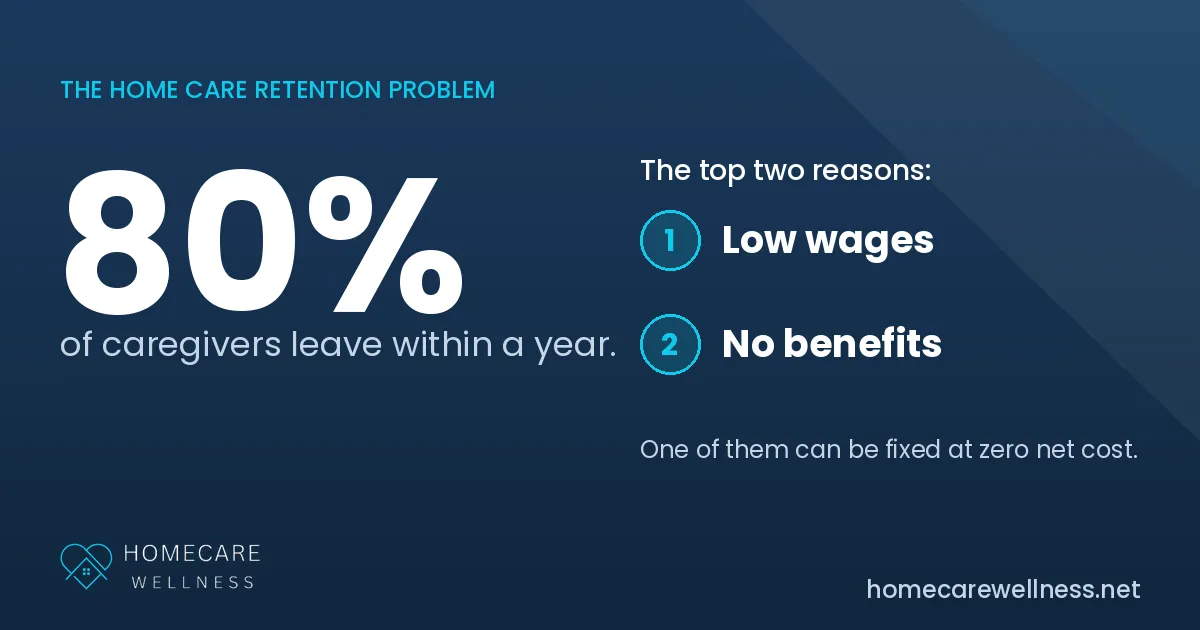
Caregiver turnover ran 75.5% in 2025. On a 40-caregiver roster that is roughly 30 hires a year, and at the industry's 9.6% applicant-to-hire rate it takes about 313 applicants to make them. The dollar cost of that gets discussed. The calendar cost does not. Almost all of it lands on the owner.
Open your agency's job listing. Look at the date it first went up.
At most agencies running 20 to 80 caregivers that posting has never come down, it just gets refreshed, reworded, boosted, paused when the schedule fills, then put back up. The budget line says recruiting. The work is replacement.
None of that is a management failure. At 75.5% turnover three of every four positions change hands inside a year, so a permanent posting is the correct response to the conditions.
What goes unpriced is the hours. Screening, calling, scheduling, no-shows, orientation, then the ones who work two shifts and vanish.
How big is the recruiting load?
Two figures from the 2026 Activated Insights Benchmarking Report set it: caregiver turnover held at 75.5% in 2025, and only 9.6% of home-based care applicants got hired.
Run those against forty caregivers. Thirty separations, thirty hires, and roughly 313 applicants through your inbox to produce them, which is one new hire every twelve days.
Source changes what you get for those hours.
| Where the hire came from | Median caregiver turnover |
|---|---|
| The agency's own website | 65.8% |
| Employee referrals | 76.7% |
| Word of mouth | 77.1% |
| Social media | 107.0% |
Social media hires leave faster than you can replace them. That is the same recruiting hour, spent twice.
"I already ran the numbers on benefits"
Most owners have. You costed a raise and a group plan, and both needed money the margin does not hold.
Two dollars an hour on a thirty-hour caregiver is $3,120 a year, plus 7.65% in employer FICA on top of it, which comes to $3,359 a year for one caregiver. Across forty of them that is $134,360. On a 7 to 10 percent net margin, that is the margin.
A Section 125 wellness plan is funded from somewhere else: it redirects employer payroll tax you already remit, so it never competes with the wage you are paying. We ran the replacement-cost arithmetic separately.
"My caregivers are part time, so this will not apply"
The thirty-hour threshold in your head is a group health carrier rule. It is not tax law. A Section 125 election is open to W-2 employees regardless of scheduled hours, which is why it reaches a part of the roster that group health never could.
The plan design carries a CPA opinion from CBIZ and a legal assurance from HitesmanLaw, both on the compliance page. The longer version of that objection lives on its own page.
Where this stops working
Pay still moves turnover, and the data is blunt about it. Agencies paying $15.00 to $17.99 an hour posted median caregiver turnover of 84.4%, while agencies paying $18.00 to $19.99 posted 53.0%.
A wellness plan is not a raise. It will not reproduce that gap on its own. What it does is give you something to offer at a wage you can sustain, and if your rate sits well under the local market then the other levers come first.
What would this look like at your agency?
Two inputs answer it: how many caregivers you run, and roughly what they earn. That is the whole ask, small on purpose.
The estimator takes those two numbers and shows what the agency pays in employer payroll tax today, what turnover at the industry median is costing, and what could be redirected into caregiver benefits instead. Thirty seconds. No signup.
For scale: UnifyWell's published example nets an employer roughly $640 per participating employee per year on a $44,000 earner, after the monthly administration fee. Caregiver wages sit below that. Across our own proposals the figure has landed somewhere between $300 and $900 per participating employee per year, which is a range and not a quote.
Which of your caregivers qualify, and what actually lands on their check, only your own numbers can answer. Have your CPA read the plan documents first.
See what your payroll tax is already funding
Two numbers, thirty seconds, and a figure you can hold against the week you are spending now.
Free. No signup, no documents, no sales call to get the number.
Home Care Wellness is not a law firm, an accounting firm, or an insurance company, and a Section 125 wellness plan is not health insurance. This is general information, not advice. Figures shown are estimates based on published industry medians and on UnifyWell's published plan example, and they are not a guarantee of results and not a quote. Plan design, eligibility and tax treatment depend on your own facts, so review the plan documents with your own CPA or counsel before adopting any plan.