Health Benefits for Part-Time Caregivers: What's Actually Possible
Forty-six percent of home care workers are part-time. A group health plan will not take them. The thirty-hour line is a carrier's underwriting rule rather than tax law, and a Section 125 wellness plan, an ICHRA and a taxable stipend all work at any hour count. The money is the real question.
Open the employee handbook at a forty-caregiver agency and turn to the health benefits page. Count the people that page applies to.
At a lot of agencies the honest answer is one. It is the owner.
Nothing about that is careless. The eligibility line was written by a group carrier who needed a clean number to underwrite against, and the number they landed on was thirty hours a week. PHI puts 46 percent of home care workers below 35 hours. The page is accurate and empty.
Why does thirty hours decide everything?
Thirty hours is an insurance threshold. It governs who a group carrier will enroll, and for applicable large employers it governs who has to be offered coverage under the ACA each year. It says nothing about who may participate in a Section 125 plan.
The IRS defines a cafeteria plan participant as a current common-law employee. Publication 15-B sets no hours floor. A caregiver on 22 hours a week is a W-2 employee, so the election is open to her on the same footing as the scheduler who works fifty.
What can a part-time caregiver actually be offered?
Four routes. The third column is where they separate.
| Option | Who qualifies | What it costs the agency |
|---|---|---|
| Group health plan | Usually 30 hours and up, set by the carrier and not by you | Roughly $9,325 a year per enrolled caregiver at the 2025 national average for single coverage |
| Taxable cash stipend | Anyone you name | Whatever you hand out, plus 7.65 percent employer FICA on top, and the caregiver pays tax on it again at her end |
| ICHRA, part-time class | Part-time can be its own class under the ICHRA class rules | Whatever you choose to fund, with no employer payroll tax on the reimbursement itself |
| Section 125 wellness plan | W-2 employees. Hours are not the test | Funded by redirecting employer payroll tax the agency already pays, plus a monthly per-participant administration fee |
The last row is the one owners squint at. They are right to. Section 125 has been in the tax code since 1978, regulators objected to one specific double-dipping design rather than to the section itself, and the plan Home Care Wellness places carries a CPA opinion from CBIZ alongside a legal assurance from HitesmanLaw. If you want the objections taken one at a time, that argument has its own page.
You already ran this and it did not work
You costed two things. A raise, and a group plan. Both of them start by asking for money the agency does not have, which is why the spreadsheet got closed and the idea got shelved for a quarter.
Two dollars an hour for a caregiver working 25 hours a week runs like this.
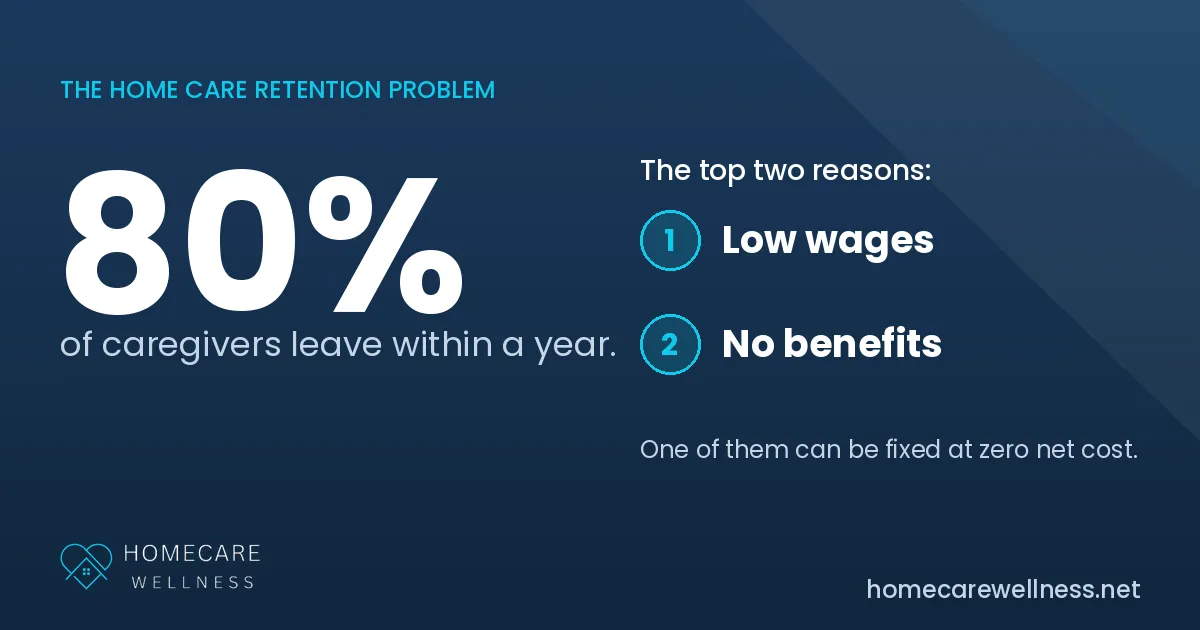
On a 7 to 10 percent net margin, that is the margin. The money leaves anyway. Turnover at the industry median is running 75.5 percent, and every departure carries a replacement cost whether you budgeted for it or not, which is the line the raise math never puts on the page. The third route does not ask for new money.
Where this does not work
Very low hours. A caregiver picking up eight or ten hours a week may not have enough taxable wages in a given month for an election to be worth making. That limit is real, it shows up at the individual level rather than the agency level, and no plan design argues it away.
This is also not insurance. It is a wellness plan, and what any one caregiver sees on her check depends on the program design and on her own numbers rather than on a headline figure. Anyone quoting an identical result for every caregiver is guessing.
What would this look like at your agency?
Two inputs answer it. How many caregivers you employ, and what they earn on average, which is the whole ask and stays deliberately small so nobody has to go pulling files to find a number.
The estimator takes those two numbers and shows three things: what the agency currently pays in employer payroll tax, what turnover at the industry median is costing you against that, and what could be redirected into caregiver benefits instead. Thirty seconds. No signup.
On scale, be careful with anyone who quotes a number before seeing yours. UnifyWell's published example nets an employer roughly $640 per participating employee per year on a $44,000 earner, after the monthly administration fee has been taken out of it. Caregiver wages sit below that. Across Home Care Wellness's own proposals the figure has landed between $300 and $900 per participating employee per year. That is a range and not a quote.
The question underneath is which of your caregivers qualify and what actually lands on their check, and no vendor can answer that from the outside without seeing your roster. Only your numbers do. Start with how the plan is built if you want the mechanics first, then have your own CPA read the plan documents. If the calendar worries you more than the money does, the setup runs on a payroll cycle rather than a quarter.
Open the estimator
Enter your caregiver count and average wage. See what your agency is already paying in employer payroll tax, and what part of it could fund benefits instead.
Open the estimatorFree. No signup, no documents, no sales call attached.
Home Care Wellness provides general information about the Unify Wellness Plan and does not provide tax, legal or accounting advice. Figures shown are estimates based on published third-party data and prior proposals, are not guaranteed, and will differ for every agency depending on wages, hours and participation. This plan is not insurance. Employers should review plan documents with their own CPA and legal counsel before adopting any plan.